
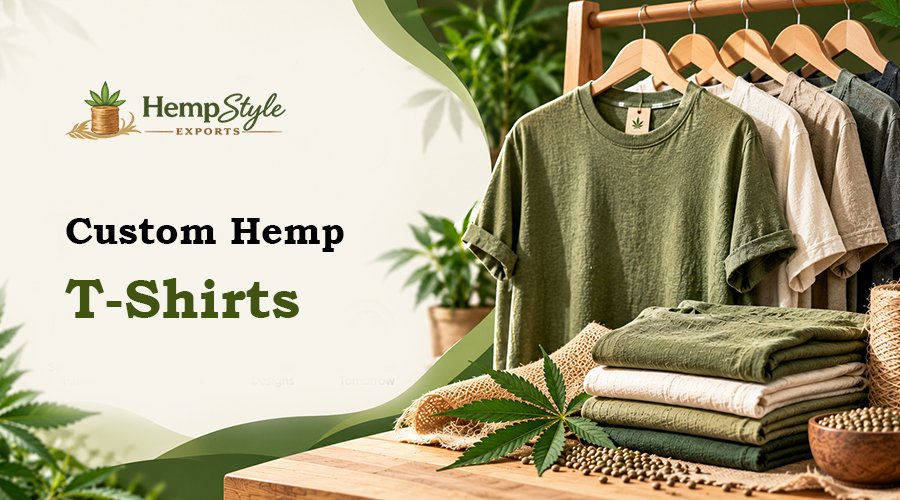
New hemp buyers tend to circle the same handful of worries, over and over. Will the fabric feel rough against skin? How heavy should a tee actually be? What’s the smallest order a factory will even take, and how long before the cartons show up at the dock? Fair questions, all of them. A T-shirt looks like the simplest garment in existence — right up until somebody actually has to specify one on paper.
What follows walks through those questions the way a production person would answer them across a cutting table, not the way a glossy brochure would. The specifics on fabrics, weights, minimums, and checks come straight from what one hemp t-shirt manufacturer in India puts in writing about its own operation.
Most of this centres on hemp blend t shirts, since blends are what the majority of brands end up ordering anyway.
So What Are Hemp Blend T Shirts, Exactly?
A tee knitted from yarn that’s part hemp, part something else. That’s really the whole definition — though the “something else” changes the finished shirt a lot more than people expect going in.
Cotton’s the usual partner. It softens the hand and gives customers a feel they already recognise, so a hemp-cotton tee rarely needs explaining on the shop floor. Throw a little spandex into that mix and suddenly the fabric stretches and snaps back, which is exactly what yoga tops and fitted styles need. Bamboo and lyocell show up too, less often but worth knowing about.
Can you get a tee in 100% hemp? Sure, factories make those. Whether to blend at all comes down to the comfort, texture, stretch, and performance a brand’s actually chasing, and the answer shifts from one range to the next — there’s no single right call here.
If you genuinely can’t decide, don’t try deciding it on paper. Ask for swatches of two or three fabrics, lay them out on a table, and just handle them. Ten minutes doing that beats an entire afternoon squinting at spec sheets.
What’s Different About Hemp Jersey T Shirts Compared With Ordinary Cotton Ones?
Jersey’s just the knit, nothing more exotic than that. Nearly every T-shirt sitting in anyone’s drawer is jersey — that soft fabric with a bit of natural give to it. So hemp jersey t shirts aren’t some strange niche category. They’re ordinary tees where hemp’s replaced some or all of the cotton in the yarn itself.
What hemp actually brings to the table is easy enough to list out. It’s a crop that gets by on less water and fewer chemical inputs than cotton needs. The fabric lets air move through it, and it wears well — as in, still looks decent a year later, not falling apart after a season. Hemp’s naturally antibacterial too, which isn’t a bad trait at all in something sitting against skin all day long.
So is it better than cotton? Depends what “better” means to you, honestly. Nothing beats plain cotton for softness straight out of the bag, fresh off the shelf. Where hemp jersey pulls ahead is lifespan — and in giving a brand something real to say when a customer asks how the shirt actually came to be. Plenty of labels split the difference and go hemp-cotton jersey, taking a share of both worlds.
How Heavy Should the Fabric Be?
This is the GSM question, and it trips up more first orders than anything else on this list. GSM stands for grams per square metre. Higher number, heavier cloth — simple as that.
For tees specifically, the weights fall into three rough bands. Light sits at 90 to 150 GSM, the kind of fabric that works for summer wear and innerwear. Medium runs 150 to 220, covering the standard everyday tee most people reach for. Heavy is 220 to 300, with that dense, premium hand streetwear brands tend to go hunting for specifically.
The mistake people make is picking a weight because it sounds impressive. A 240 GSM tee feels wonderful in the hand — and then sits in the drawer the moment the weather turns hot. A 130 GSM one is a genuine pleasure in August, but can come across flimsy next to heavier competition on a rack. Think hard about where and when people will actually wear the shirt, then choose from there.
And if you’re torn between two weights, remember GSM isn’t fixed in stone. Factories making hemp jersey t-shirts adjust it to the design constantly, so just get a swatch from each band and compare them side by side.
Which Styles Will a Hemp T Shirts Manufacturer Make?
Crew neck, obviously — that’s what most people picture when they hear “T-shirt” at all. Beyond that, a hemp t-shirt manufacturer specialising in the category will typically also do V-necks, oversized fits, unisex cuts, and tops built for yoga and other activewear. Then there’s custom work, where a brand shows up with its own idea and the factory builds a pattern around it from scratch.
Style and fabric aren’t separate decisions either, worth saying. An oversized streetwear tee wants real weight behind it, so heavyweight hemp jersey is the natural fit there. A yoga top has to move with the body, which means hemp-cotton-spandex, no way around it. Your relaxed everyday unisex tee is happiest in a mid-weight hemp-cotton. Tell the factory what the shirt’s actually for, and they can point you toward the right cloth without much back-and-forth.
And for Yoga or Gym Wear, Does Hemp Hold Up?
It does, provided the blend’s right. Hemp-blend fabrics breathe well, handle moisture decently, and survive a lot of wearing and washing — all things activewear genuinely demands of a fabric. Stretch is a separate matter, though. That comes from the blend itself, from cotton or, better still, a touch of spandex worked in for comfort and freedom of movement.
Seams matter more here than on a casual tee, too. Units making yoga and active tops run flatlock machines, and the flat seams those produce don’t rub against skin while the body’s moving around. Worth asking any factory outright, before sending over an activewear brief: are there flatlock machines actually on the floor?
Don’t sign off on fit from a flat measurement alone either. Get somebody to wear the sample and stretch in it properly. A top can measure perfectly on paper and still ride up the second the wearer bends forward.
How Much of a Tee Can You Customise? A Look at Custom Hemp T Shirts
Nearly all of it — which tends to surprise people who assume custom just means a logo slapped on the chest.
With custom hemp t shirts, the pattern itself can be entirely yours. That covers fit, sizing, how oversized the silhouette runs, the shape of the neckline, all of it. The dye house matches whatever shade you specify. Artwork goes on using eco-friendly printing methods.
After that comes branding, and this is really the part that turns a factory’s generic tee into your tee specifically. Your own neck label. Your hang tag. Trims and packaging to match the rest of the range. Nothing on the finished garment points back toward whoever actually made it — which is basically all “private label” ever really means.
One word of caution, though. Each custom choice is one more thing that needs to be right, so don’t show up with a vague idea and just hope it works out. Bring reference pictures, measurements for every size (not just a medium), colour codes, and print-ready artwork ready to go.
What Does Sampling Involve?
Swatches first, then a sewn sample afterward.
Swatches are small cuttings of fabric. They tell you about texture, handfeel, and weight — nothing more, nothing less. The sewn sample is a finished tee, built in your fabric and your fit, and it tells you everything else: how the shirt hangs on a body, how the neck sits, whether the stitching’s actually tidy up close.
Be rough with that sample, genuinely rough. Put it through the wash two or three times and measure it before and after each round. Turn it inside out and actually look at the seams. Wear it for a full day. If something bothers you, speak up right away — a change at sample stage costs almost nothing, and the same change after bulk cutting costs a great deal.
Any decent hemp cotton t-shirt supplier provides swatches and sample development without needing to be pushed into it. Once you approve the sample, hold onto it carefully. That one shirt is now the reference point for the entire order going forward.
Hemp T Shirts Wholesale: What’s the Minimum, and How Long Does an Order Take?
Everybody wants one clean number for each of these. It’s never quite that tidy, unfortunately.
Minimums for hemp t-shirts wholesale orders shift with the style, the fabric type, how much customisation’s been asked for, and the number of colours involved. For a rough sense of scale, one published bulk figure out of India sits at 1,000 units per style, per colour. Colour counts separately because each shade needs its own dye batch, run on its own.
Is that number set in stone? Not always, actually. Some factories describe their MOQs as flexible and will plan production around a growing brand’s trajectory — so if your first order’s smaller, just say so upfront and see what’s actually possible.
On timing, average production lead time runs around 30 to 35 days. Bigger quantities, fabric that isn’t readily on hand, heavy customisation, or a busy production schedule can all stretch that out further. You’ll normally only get a firm date after the order’s confirmed and the sample’s approved — not before.
So count backwards from your launch date. Subtract shipping. Subtract production. Subtract sampling. That tells you when the first email actually needs to go out. A hemp cotton t shirts supplier can’t rescue a deadline nobody bothered telling them about in the first place.
What Goes On After You Approve the Sample?
Five things, in a fixed order — and knowing them makes a factory’s progress updates much easier to actually follow along with.
The fabric arrives first and somebody inspects it. Sampling, which you’ve already been through by this point, sits second in the official sequence. Third is bulk cutting and stitching, run on industrial cutting machines and then lockstitch and overlock machines down the sewing lines. Quality checks come fourth. Finishing, packing, and export close things out at the end.
Reasonable to ask how much a unit can actually produce, too. Capacity differs hugely from one factory to the next, and a larger Indian hemp unit might manage somewhere between 30,000 and 60,000 garments a month across all its categories combined. That matters less on your first order than it will on your third, once volumes have grown and you’d really rather not go hunting for a new supplier mid-stride. Worth asking, while you’re at it, how the unit schedules repeat and seasonal orders too.
How Can You Tell Whether a Hemp Cotton T Shirts Supplier Takes Quality Seriously?
Ask what it checks, and at which exact point in the process — then actually listen to the answer. A hemp cotton t-shirt supplier running a real system will reel the steps off in order, without hesitating.
Good ones start before cutting even begins. Inspectors go over the fabric and test it for GSM and shrinkage. Shrinkage is the big one, honestly — a tee that drops a size in its first wash comes straight back to the shop, no question. While the lines are running, checkers examine stitches and test seam strength as they go. Someone compares measurements against the size chart directly. Right at the end there’s a final random inspection before dispatch, plus a check on the export packing itself.
Hesitation or vague waffling at this stage tells you plenty, by the way — more than you’d think.
Nothing stops you from doing some checking of your own once the goods actually arrive, either. Put a bulk shirt beside your approved sample. Weigh one. Pull a few at random from different cartons and wash them. Give the side seams and neck rib a gentle tug. Fifteen minutes of work, and it shows whether the standard held steady from the first carton through to the last.
What Makes Sustainable Hemp T Shirts Worth the Name?
Good question, honestly, because the word turns up on a lot of hangtags that haven’t really earned it.
Part of the answer’s the plant itself. Hemp grows with less water and fewer chemical inputs, so the footprint’s lower before any yarn even exists yet. But the fibre’s only where sustainable hemp t shirts begin — not where the story ends.
What happens inside the factory counts just as much, maybe more. Dyes should be eco-friendly ones. Processes should go easy on water and energy, and somebody needs an actual plan for the waste generated. A clean fibre dyed carelessly isn’t a sustainable garment, whatever the hangtag claims.
Then there’s the people actually doing the sewing. Ethical labour practices and safe working conditions are part of the definition here, not some optional add-on tacked onto the end.
So how do you check any of that from another continent, realistically? Paper. Ask about GOTS-certified fabric and OEKO-TEX certification, and ask to actually see the documents themselves. Factories doing things properly keep that paperwork close at hand, ready to go.
Who Orders These Tees, and Where Do They End Up?
All sorts, really. Sustainable fashion brands, as you’d expect. Yoga and activewear labels, drawn to the breathability and the stretch blends specifically. Lifestyle and casualwear labels after a dependable everyday tee they can rely on. Private label programmes. And stores or distributors buying hemp t-shirts wholesale in genuine bulk.
As for where the cartons actually go, Indian exporters send them out to the USA, the UK, Europe, Australia, and further afield still. Export-ready means the factory packs to international standards and double-checks the packing before anything leaves the building.
A brand selling sustainable hemp t shirts overseas already has plenty to manage without also chasing three separate companies for fabric, stitching, and shipping paperwork on top of everything else.
What’s the Best Way to Get an Order Started?
Write to the factory and be specific about it. Vague messages just get vague replies back — every time.
A useful first message names the style (crew, V-neck, oversized, whatever it happens to be), the fabric or blend, the GSM you’re aiming for, sizes, colours, and quantity per style. Say what printing and labelling you’ll actually need. Give the launch date and the country the goods are headed to. Got a tech pack, or a tee you’d like to match? Attach it, or just send a photo over.
You can usually reach a factory through a quote form on its site, by email, or over WhatsApp — and some will set up a call if you’d rather talk it through.
After that it runs in a fairly predictable line: swatches, sample, approval, bulk, quality checks, packing, export. A capable hemp t shirts manufacturer keeps you posted at each step along the way. And a bit of encouragement here for anyone ordering hemp blend t shirts for the first time — the second order’s far less work overall, since the patterns, specs, and approved sample are already sitting in the factory’s files, ready to go.
Conclusion: Know the Purpose, Then Check the Details
Strip the jargon away and nearly every question here comes back to one thing: matching a fabric to a job it actually needs to do. Work out who’ll wear the tee, and when. Choose the blend and the weight for that specific person. Get a sample and genuinely treat it badly before you sign off on it.
The rest is housekeeping, more or less — though it’s the kind of housekeeping that saves real money down the line. Settle the minimum and the timeline in writing, nothing verbal. Find out exactly what the factory inspects, and when. Look at its certificates properly. When the order finally arrives, hold it up against your sample and check.
Buyers who ask these things early on tend to have a much quieter time of it later — worth remembering that.
For brands that already have the answers they need and want samples in hand, Hemp Style Exports (hempstyleexports.com) makes hemp and blended tees in India with custom GSM options, private labelling, and export-ready production, and takes inquiries by quote form, email, or WhatsApp.
