
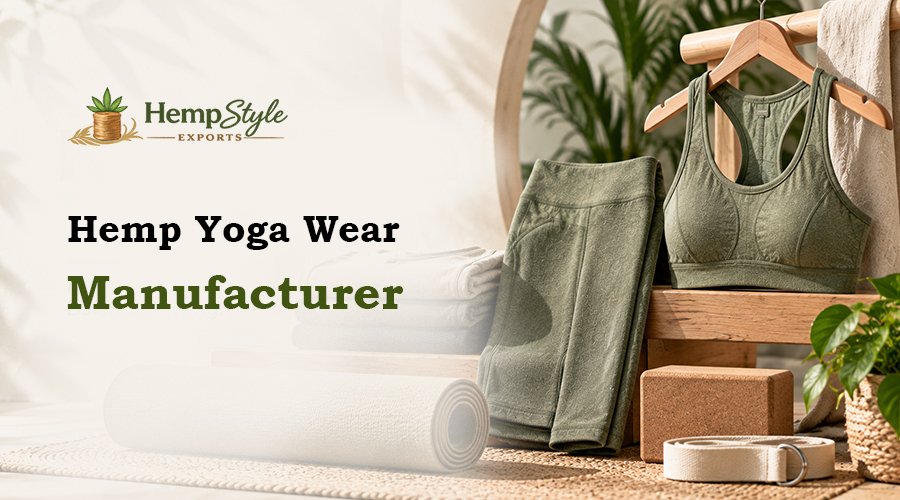
Leggings. A top. Maybe a bra and a pair of shorts. How hard can buying that be?
Harder than it looks, as anyone who has opened a factory spec sheet will confirm. Jersey. GSM. Recovery. Lyocell. Four words in and most people are searching the internet under the table.
Relax. Underneath the jargon sit four plain questions, and they’re the same four for somebody buying one pair of leggings as for a brand ordering three thousand. What’s the hemp mixed with? How heavy is the cloth? How far does it stretch? What happens in the wash?
Those come first here. After them, the trade side: telling a real sustainable yoga wear manufacturer from a pretend one, what a bulk order involves, how much of a garment can be made your own. Fabric names, weights and tests below come from what one hemp yoga wear manufacturer has put in writing about its own production.
Question One: Hemp, and What Else?
“Hemp” on a swing tag almost never means only hemp. Five fabrics turn up again and again in activewear, and no two of them behave alike.
Start with a 100% hemp jersey, the purist’s pick. All plants. Breathes well, wears hard, has a faint texture under the fingers. It gives less than the spandex blends do, so it’s happier in loose pieces than in anything tight.
Hemp and cotton jersey is the friendly one. Cotton takes the edge off and makes the cloth feel familiar from the first touch, which is why it ends up in relaxed yoga tops and casual shorts.
Then the workhorse: hemp, cotton and spandex. A little spandex goes a long way. It’s the reason leggings, bras and close-fitting tops can follow a body through a stretch and then return to where they started. Anything that has to hug ends up in this blend more often than not.
(A note on the word “jersey”, since it keeps cropping up. It’s a knit. The same soft, slightly springy knit as a T-shirt, and it’s what makes even pure hemp yoga wear feel like clothing instead of a grain sack.)
That leaves hemp with bamboo and hemp with lyocell. Both are on offer for yoga wear. Words are a poor substitute for handling them, so ask for swatches and trust your fingers.
Why so many options? Factories pick between them to get more comfort, more breathability, better moisture management or more flexibility out of a garment. A decent hemp yoga clothing supplier asks what the piece is for before suggesting any of them. Use first, blend second. Never the other way about.
Question Two: How Heavy? (GSM, Minus the Mystery)
GSM. Grams per square metre. Bigger number, heavier and denser cloth. That’s the entire definition, and it still manages to decide how a garment feels, how it hangs and how long it lasts.
For yoga wear, a hemp yoga wear manufacturer in India lists three bands: lightweight at 150 to 220 GSM, medium at 220 to 300, heavyweight from 300 up to 450.
Which goes where? Lighter cloth suits yoga tops and summery, loungey pieces, where air matters more than hold. The middle is everyday territory. Leggings, and anything else that must stay opaque and supportive, belong further up. The heaviest fabrics are for premium pieces with some real heft.
Two mistakes happen over and over. First, leggings ordered in a weight meant for tops; they arrive thin, and under bright light they’re see-through. Second, a studio top ordered too heavy, which nobody wants to wear in a hot room. The fabric isn’t at fault in either case. Somebody just picked the wrong weight for the job.
Leggings, incidentally, have published bands of their own. 180 to 220 GSM for daily wear. 220 to 280 for stretch and compression. 280 to 320 for high-end activewear.
And nobody is stuck with three choices, because GSM can change to suit the design. Torn between two? Get a swatch of each, stretch it over a hand, and look.
Question Three: How Much Stretch, and Where Does It Come From?
This is the one that worries people about hemp, so here’s the plain version. Hemp activewear stretches because of what’s blended in. Cotton gives a bit. Spandex gives a lot, and it brings recovery with it, which is a fabric’s knack of going back to its shape once you let go.
How much is enough? Depends entirely on the garment. A loose top needs next to none. Shorts need some. Leggings and bras need plenty. Compression styles need the most of all. Factories build accordingly, with stretch-focused designs and compression styles on one side and easier fits on the other.
Don’t judge stretch without recovery, though. Cloth that stretches and stays stretched means baggy knees before lunch. It’s also why a careful hemp yoga wear manufacturer tests stretch and seam strength as part of quality control. A seam that can’t move with the fabric is the first thing to split.
Fit matters here too, more than people think. Cut the pattern right and the garment needs far less elastic muscle to stay where it’s put. Custom fits, silhouettes and sizing are all on the table, handy if your customers don’t match a standard size chart.
Beyond Leggings: What a Hemp Yoga Clothing Supplier Makes
Everybody talks about the leggings. There’s more on the rail than that.
The product list from a typical hemp yoga clothing supplier has yoga tops and leggings on it, yes, but also yoga bras (some call them sports bras), shorts, unisex pieces and activewear sets that match. Custom work too, for a brand that arrives with a sketch and wants a pattern made from it.
One habit saves trouble later: buy in outfits. People pick up leggings and then look round for a top. They want the same shade. They want cloth that feels related. When a single unit makes both pieces, colour, handfeel and sizing line up without any chasing.
That isn’t an argument for one fabric across the board. A top is fine lighter and looser. A bra has to hold and stretch. Shorts sit between the two. Say how people will wear each piece and the factory picks a blend and a weight to suit.
Who’s Buying This Stuff?
Shoppers, to begin with. They come for comfort and stay for the fabric story: something breathable enough for class, ordinary enough for the walk home afterwards.
Then the trade. Yoga and wellness brands. Sustainable activewear labels. Fitness and athleisure collections, private label programmes, wholesalers buying in bulk. Their reasons rhyme. A fibre with a low-impact start in life, natural antibacterial properties and a long working life is easy to explain to a customer.
But Will It Cope With a Hard Session?
Reasonable thing to ask. Hemp has a soft, earthy image, and people mistake soft for fragile.
Wrongly. Hemp-blend fabrics do well in yoga and activewear because they breathe, they last and they manage moisture, and hemp is naturally antibacterial on top, no small thing in clothes that spend their life soaking up sweat. Yoga, pilates, gym work, general training: a good blend handles all of it without complaint.
Where to keep expectations in check? At the far end of compression. Synthetic performance fabrics exist to squeeze as hard as possible, and a hemp blend isn’t pretending to be one. Most people will never notice the difference. A brand selling to serious sprinters should test samples hard before it commits.
Better than any argument is a sewn sample. Ask a hemp activewear supplier for one, then take it to exactly the kind of workout it’s meant for. One sweaty hour beats a page of promises.
Question Four: Care, or How to Make It Last
Treat hemp activewear as you’d treat any stretch garment.
The care label wins every argument, because somebody wrote it for that exact fabric. Past that, a few habits are standard advice for anything with spandex in it. Cool wash. Inside out. Gentle on the heat when drying, since high temperatures are hard on stretch fibres.
Shrinkage is the other fear, and part of that one belongs to the factory. A responsible hemp yoga wear manufacturer tests cloth for GSM and shrinkage before it cuts, so the size you bought is still the size you own a month later. Brands should ask to see the results. They should also wash their own sample, several times, before signing it off, and check the colour while they’re at it. Has a dark piece faded? Has it bled onto anything?
One more for brands. Agree the care instructions with the factory, print them clearly and keep them short. People follow three lines. They skip twelve.
Real or Fake? Sizing Up a Sustainable Yoga Wear Manufacturer
Activewear is drowning in green claims. A fair number collapse at the second question, so make a habit of asking it.
Fibre is where to start. Hemp needs less water and fewer chemical inputs, and that’s a strong opening hand. Still, a sustainable yoga wear manufacturer has to show more than a good raw material.
How does the cloth get its colour? Eco-friendly dyes and low-impact processes ought to feature in the reply. What about water and energy? Waste? And who is doing the sewing, on what terms? Ethical labour belongs inside the definition. It isn’t an optional extra.
Then, proof. Two documents are worth asking for by name: GOTS-certified fabric and OEKO-TEX certification. Typing “eco” on a homepage costs nothing. Certificates are harder to conjure.
Here’s a rough-and-ready greenwashing test. Vague wording, no paperwork, and an odd reluctance to send samples. Those three tend to arrive together. A genuine sustainable yoga wear manufacturer is the opposite, specific to the point of dullness about blends, tests and documents.
Keep your own marketing just as clean, by the way. Stretch blends contain a little spandex, and spandex is synthetic. Say so on the label. Customers forgive candour a great deal faster than they forgive a surprise.
Bulk Orders: What a Hemp Activewear Supplier Will Want to Know
Wholesale has a rhythm. Knowing it before the first email saves a lot of back and forth.
Quantity first. No single minimum exists, since MOQ moves with the product type, the blend, how much is custom and how many colours you want. One published benchmark: 1,000 units per style and per colour. Factories with flexible MOQs will talk newer brands through the options.
Timing second. Production averages 30 to 35 days, and that clock only starts after sample approval and order confirmation. Bigger orders, unusual fabrics and heavy customisation all add days.
Sampling comes before either. Swatches, then a sewn sample, which is how a good hemp activewear supplier lets a buyer judge quality, fit, construction and performance before any bulk cutting.
Quality control should be on the table too. Any hemp yoga wear manufacturer worth dealing with will list it without prompting: fabric inspection before production, GSM and shrinkage testing, stretch and seam strength checks, measurement verification, a final random inspection before dispatch. Export orders get a packing check as well.
Come with answers of your own. Which pieces? What blend, what GSM? Sizes, colours, quantities? Delivery when, and to which country? A sharp brief gets a sharp quote.
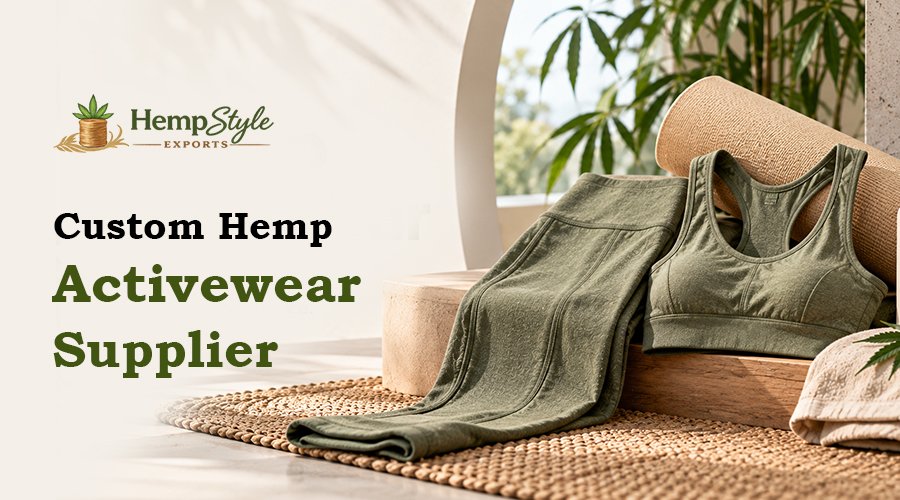
What a Custom Hemp Activewear Supplier Can Change
Nearly everything. Really.
The pattern can be yours: fit, silhouette, sizing. The dye house matches colours to your palette. Prints go on by eco-friendly methods. Stretch and compression follow whoever you have in mind as the wearer.
After that comes private labeling, the step that turns a factory’s garment into yours. A custom hemp activewear supplier adds your labels, brand tags, trims and packaging, and by the end nothing in the parcel mentions anyone else.
Worth the bother? For a brand, yes. A stock design with a logo on it looks like everybody else’s stock design with a logo on it. A cut and a colour of your own give people a reason to come back to you and nobody else. And a sustainable yoga wear manufacturer with proper private label support takes the choices one at a time.
Leave slack in the timeline, though. Each custom detail is a decision. Sometimes it’s a second sample too.
Why a Hemp Yoga Wear Manufacturer in India Makes So Many Shortlists
Three reasons, mainly.
Range, for one. Pure hemp plus four blends, custom GSM and the full set of yoga pieces, all out of a single unit: that’s what a hemp yoga wear manufacturer in India can put on the table.
Export habits, for another. Indian factories ship to the USA, the UK, Europe and Australia. Finishing and packing follow export standards, and someone verifies the packing before dispatch.
And flexibility. With sampling support, flexible MOQs and production planning for new brands and established labels alike, starting small and growing later is a realistic plan.
Getting in touch takes minutes. A quote form, an email, a WhatsApp message; some factories will book a call. Send the brief and ask for swatches in the same breath.
Conclusion: Four Questions and a Sample
Take away the jargon and hemp activewear comes down to those four questions. What’s the blend? What’s the weight? Does it stretch, and does it come back? How should it go through the wash? Clear answers to those remove most of the risk.
What’s left is homework. Ask for the certificates. Ask what the factory tests. Wear the sample, wash it, wear it again.
Then choosing between fabrics stops being a guess.
Brands that want to try the fabrics for themselves can ask Hemp Style Exports (https://hempstyleexports.com/) for swatches and samples. The company makes yoga tops, leggings, bras and shorts in India in 100% hemp and blended fabrics, with custom GSM, private labeling and export-ready production.
