
Question a small clothes label on what keeps them awake at night and the answer is often not the design. It’s sourcing. Finding a mill that answers emails, a factory that hits a deadline, a fabric that behaves the same way in the tenth production run as it did in the sample. Add sustainability requirements on top and the shortlist gets very short indeed.
That’s the backdrop against which hemp has quietly moved from novelty to serious option. Ten years ago the fibre had an image problem and a texture problem. Neither really applies now. Modern spinning and blending have turned it into something you’d struggle to distinguish from a good cotton tee by touch alone, and custom hemp t-shirts have become a legitimate core product rather than a curiosity item at the back of a range.
This guide walks through the fabric, the blends, the weights, the manufacturing side, and the practical stuff nobody tells you until an order goes wrong.
Why Custom Hemp T Shirts Have Gained Ground
To start with, consider the plant itself: the hemp plant grows rapidly, requires not just a fraction of the amount of water that traditional cotton uses, and survives fairly happily with minimal pesticides input. For a brand writing its sustainability page, that’s a claim with real substance behind it — not the usual vague talk of “eco-conscious sourcing.”
The fibre has properties that matter in a finished garment too. It’s naturally antibacterial, which means shirts stay fresher through a long day. It’s breathable, so it handles heat well. And it’s really durable — hemp fibre is stronger than cotton, and garments made from it survive more wash cycles before losing shape.
There’s a commercial side too. Shoppers increasingly ask what a garment is made from. Not everyone, but enough that a brand with a credible material story sees better conversion than one without. Custom hemp t shirts give a label something real to say on a product page, beyond fit and colourway.
Pricing has shifted as well. Demand has risen and processing improvements have occurred such that much of the difference between hemp and high-quality organic cotton has narrowed. It is not gone, but it is certainly not the absolute stop block it was once.
Understanding Hemp Blend T Shirts and What Each Blend Does
Pure hemp is rarely the automatic answer. Blending changes handfeel, drape, stretch and price, and most brands end up somewhere in the blended range once they’ve felt a few swatches.
Hemp and cotton is the reliable middle ground. Using cotton can have cheaper costs and more comfort. Using hemp can make it more durable and breathability. Mainstream of the everyday t-shirt of sustainable apparels fall between here, around 55/45-60/40.
Hemp, cotton and spandex add recovery. Any fitted silhouette, anything close to the body, anything sold into activewear — that small percentage of elastane makes the difference between a shirt that holds its shape and one that goes baggy at the elbows by March.
Hemp and bamboo produce a noticeably softer, silkier handle with good moisture management. It suits yoga and wellness ranges particularly well.
Hemp and lyocell will hold a higher tier position. Lyocell adds a flowing drape, as well as a slight Sheen, giving it a place suitable for enhanced basics that are not the regular tee.
Hemp and khadi brings texture and a handwoven character. Not for everyone, but distinctive for brands leaning into craft and heritage positioning.
Then there are trio blends — hemp with cotton and linen, or hemp with cotton in a three-fibre construction — which let a manufacturer fine-tune weight and texture beyond what two fibres allow.
Choosing between hemp blend t-shirts comes down to the garment’s job. A summer tee, a gym top and a premium boxy fit all want different things from the cloth.
Working With a Hemp Cotton T Shirts Supplier
This is where projects live or die and it actually has much less to do with price than you probably believe.
First make sure that a supplier actually has expertise with hemp, and didn’t just throw it onto their product list at some arbitrary point. Hemp stitches, cuts and finishes differently than cotton- shrinkage behaves differently, dye uptake behave differently. A factory that’s been handling hemp for years knows that. One that hasn’t will just be experimenting with your production.
Ask about fabric sourcing. A serious hemp cotton t-shirt supplier should be able to say where the yarn comes from, what certifications sit behind it — GOTS and Oeko-Tex being the two that carry weight — and whether the dyes are low-impact.
Sampling matters enormously. Getting swatches before committing to bulk lets you assess texture, weight and colour under your own conditions rather than in a photograph. Any supplier reluctant to send samples is telling you something.
Then there’s quality control. Fabric inspection before production, GSM and shrinkage testing, stitch and seam strength checks, measurement accuracy, a final random inspection before dispatch. That sequence should be standard, not something you have to request.
Communication is the unglamorous piece that ends up deciding whether a season ships on time. A supplier who gets back to you within a day is worth more than one quoting ten cents less per unit and then going dark for two weeks.
What Hemp Jersey T Shirts Bring to a Range
Jersey is the knit behind nearly every t-shirt sold. It stretches, drapes, and moves with the body — and applied to hemp, it puts to rest the old complaint about the fibre feeling stiff.
Hemp jersey t shirts built from a hemp-cotton jersey construction feel close to a good cotton tee straight out of the packet, and they soften further with washing rather than degrading. That softening curve is one of hemp’s great advantages — the garment improves for a year or two before it plateaus.
Weight is where the real choices get made. Lightweight fabric in the 90 to 150 GSM range suits summer collections, layering pieces, and warmer markets best. So standard, like what you’re going to find in a daily tee, and what most orders come in are of the medium weight somewhere from 150-220 GSM. Streetwear customers really want a more heftier cloth from 220 GSM to 300 GSM where an oversized fit won’t droop.
Anyone building a full range usually needs at least two weights. A single GSM across summer and winter products rarely works.
Choosing a Hemp T Shirts Manufacturer That Can Actually Deliver
Plenty of factories will quote. Fewer can execute consistently across repeat orders, which is the thing that matters once a brand starts scaling.
Check the production capability list first — sampling and prototyping, bulk manufacturing, private labelling, custom GSM and blends, export-ready output. Miss any of those, and the gap tends to show up later, usually at the worst moment.
Customisation depth is worth digging into. A capable hemp t shirts manufacturer should be able to handle custom patterns and fits, custom colours, eco-friendly printing, neck labels, hang tags, custom trims, and branded packaging. Anything less means sourcing labels and packaging separately — extra cost and extra hassle nobody signs up for.
Ask about lead times honestly. Around 30 to 35 days is a realistic average for bulk hemp production, though it moves with quantity, fabric availability and how much customisation is involved. Anyone promising two weeks on a custom blend is either sitting on stock fabric or being optimistic.
Export experience is its own competency. Shipping into the USA, UK, Europe or Australia involves documentation, packing standards and compliance requirements that catch out factories used to domestic supply only.
Minimum order quantities need a straight conversation early. Around 1,000 units per style per colour is common for hemp production, which sounds steep until you account for the fabric being woven or knitted specifically for the order. Some manufacturers flex on this depending on the blend and complexity.
Ordering Hemp T Shirts Wholesale Without Nasty Surprises
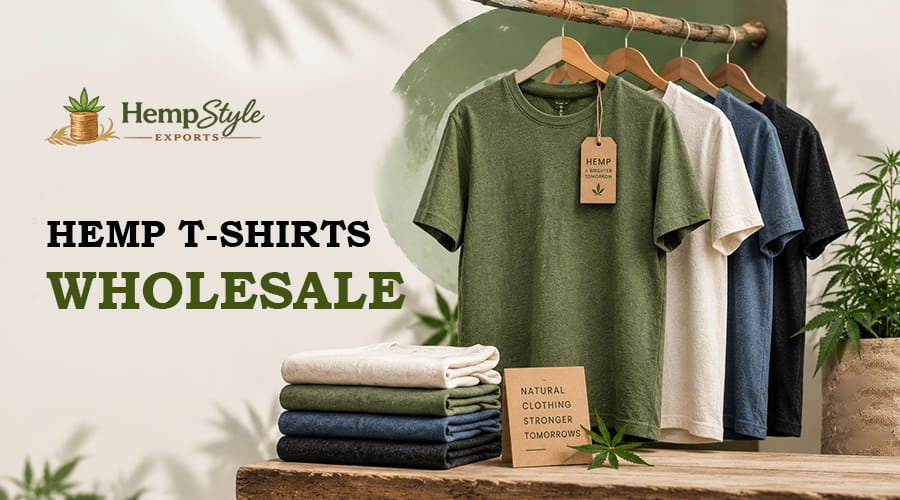
Wholesale hemp works differently to picking blanks off a shelf, and the differences are worth understanding before the first purchase order goes out.
Cost is driven by several variables at once. Fabric composition is the big one — a hemp-lyocell blend costs considerably more than hemp-cotton. GSM matters, since heavier cloth uses more yarn. Then colour count, print complexity, packaging specification and order volume all move the number.
Volume discounts are real, and they add up fast. Jumping from 1,000 to 5,000 units usually moves the per-piece price more than any amount of haggling over the base rate.
Go into any hemp t-shirts wholesale enquiry with the spec already locked in — fabric blend, GSM, colours, sizes, quantities per size, labelling, packaging, target delivery date. A loose brief gets a loose quote, followed by a few rounds of back-and-forth before anything usable comes back.
Schedule build of sampling into the production. Swatches then a sample garment then confirmation of sample then bulk. If you cut this short three weeks are shaved off and then the brand has 2000 shirts made in light olive instead of darker.
Discuss with your manufacturers payment terms and shipping. Sea freight is much cheaper than air freight and takes an extra number of weeks to arrive. If you have a launch date this will need to be accounted for so you don’t suddenly find you won’t receive stock for 4 more weeks.
Which Brands Suit Hemp Best
Sustainable fashion labels are the obvious fit, since the material story does half the marketing work.
Yoga and activewear brands do well with hemp-spandex and hemp-bamboo constructions, where breathability and antibacterial properties really improve the product rather than just reading nicely on a swing tag.
Lifestyle and casual labels use hemp for elevated basics — the sort of tee that costs more than a supermarket three-pack and justifies it through feel and longevity.
Private-label programmes work particularly well because the whole garment gets built to specification. Fit, weight, blend, labelling, packaging. Nothing about it says “generic blank with a logo added.”
A wholesale group/ bulk buy customer focused on an ecological retail market now represents a sizable grouping on its own, with demand growing strongly on that side.
Common Mistakes Worth Avoiding
Ordering bulk without physical samples tops the list. Fabric photographs are unreliable, and colour especially so.
Choosing the wrong GSM for the market is another frequent one. A 280 GSM tee sold into a hot climate sits unsold, however good the fabric is.
Underestimating shrinkage causes returns. Hemp shrinks, and pre-shrinking treatment plus accurate size grading is what prevents complaints after first wash.
Ignoring certification requirements creates problems at customs and with retail partners. If a stockist requires GOTS documentation, that needs establishing before production rather than after.
And finally, treating price as the only variable. The cheapest quote frequently costs the most once delays, quality issues and reorders get factored in.
Where the Category Is Heading
Regulation is tightening across Europe on textile sustainability claims, and vague marketing language is getting harder to defend. Materials with verifiable credentials are moving from optional to necessary.
Consumer awareness has moved too. Hemp no longer needs explaining to most buyers, which removes an education cost that brands used to carry.
Manufacturing capacity has expanded, particularly across India, where mills and garment factories have built specialisation in hemp and hemp-blend production. Hemp Style Exports operates in exactly that space, supplying global fashion brands, wholesalers and private labels from Indian production with export-ready systems.
Getting Started
No one builds a strong range solely from a spreadsheet. Order samples of the fabrics and feel them – the hand of a 160 GSM hemp-cotton versus a 240 GSM heavy-weight. Wash a fabric once and a twice and look how it behaved. That half an hour would tell you much more than a month of desk-based investigation.
Beyond that, it’s simply down to specifying your fabric match correctly, have clear communication on the specification, and finding yourself a manufacturing partner who speaks English correctly. The material’s proven it can do the job, so it’s down to what you do with it then.
