
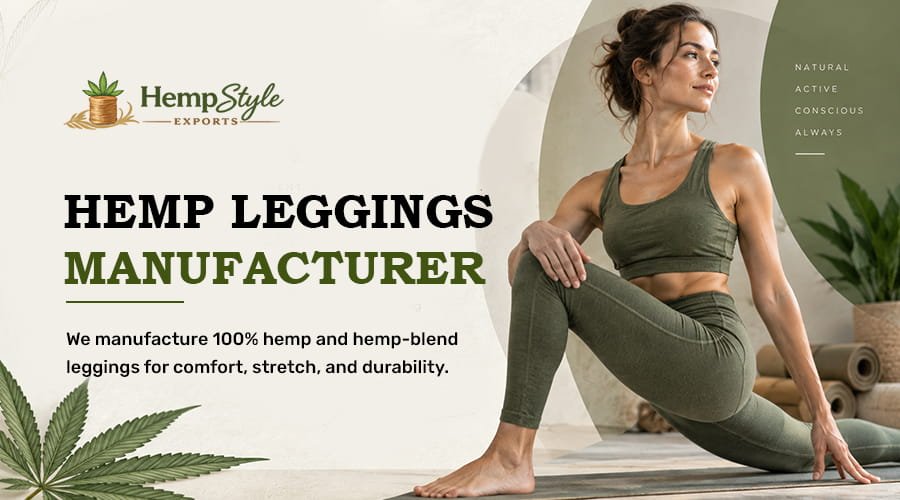
Leggings built the modern activewear industry. They also handed it its biggest credibility problem.
Walk into any studio and most of what people are wearing started life as plastic. Recycled polyester is an improvement over virgin polyester — fine, sure — but it still sheds microfibres into the wash water every single cycle, no matter how “recycled” the label claims to be. Brands know this. Customers have started catching on too, and honestly, the questions landing in inboxes have gotten sharper over the past couple of years — not vaguer, not softer, sharper.
Which is why natural fibres have come back into a category that spent twenty years chasing synthetics. Hemp’s sitting right at the centre of that shift. Blended properly, it does things polyester simply can’t — and finding the right hemp leggings manufacturer has turned into a real strategic call, not just another line on a sourcing spreadsheet.
This guide walks through how hemp behaves in stretch garments. Which blends actually hold up over time. What you need to ask a factory before signing anything. Where the real costs show up, usually later than expected. And the mistakes — the quiet ones, the kind that don’t show up until a season’s already gone sideways.
What Hemp Actually Brings to Activewear
Worth separating the marketing from the fibre properties, because they’re not the same thing.
Breathability comes first. Hemp lets air move through the fabric rather than trapping heat against skin. In a heated studio or an outdoor summer session, that difference registers within ten minutes.
Odour resistance is the one customers notice most. Hemp is naturally antibacterial, so it doesn’t develop that permanent gym-bag smell synthetics acquire after a few months. No chemical antimicrobial finish required, which matters because those finishes wash out anyway after twenty or thirty cycles.
Durability is where hemp reallyy outperforms. The fibre ranks among the strongest natural fibres available. Leggings get stretched, twisted, sweated in and washed constantly — fabric that thins out fast turns into returns and bad reviews.
Then there’s the growing side. Hemp uses far less water than cotton, and it typically grows without the pesticide load conventional cotton demands. For brands selling to people who actually bother to check claims, that story survives scrutiny — it doesn’t fall apart the moment someone starts digging.
The catch, and it’s an important one: hemp on its own has no stretch. Nobody wants a rigid legging. Which is precisely why blending is the entire craft here.
Getting the Blend Right for Hemp Stretch Leggings
This is where factories earn their money, and where inexperienced suppliers get exposed.
Hemp with cotton and spandex is the standard base for anything that needs recovery. Cotton softens the hand and adds comfort. Spandex handles the stretch, and — this is the part that matters most — the ability to actually snap back to shape after. Hemp brings strength, breathability, and the environmental story that ties it all together.
The ratio decides everything, full stop. Too little elastane and the leggings are bagging at the knee by the second wear — sometimes the first. Too much, and the natural fibre percentage drops far enough that the sustainability claim starts looking thin, the kind of thin that doesn’t survive a closer look.
Hemp stretch leggings need to move in four directions, not two. Four-way stretch matters enormously for deep squats, forward folds and anything involving hip mobility. A fabric that only stretches horizontally will pull uncomfortably during movement, and testers will report it immediately.
Hemp and bamboo produces a silkier surface with better drape. It works well for lighter leggings, capris and anything sitting close to skin where softness beats compression.
Hemp and lyocell handle moisture particularly well together. Lyocell wicks fast and feels very smooth against skin — which is exactly why it works so well for higher-intensity pieces, or anywhere the climate runs warm.
Trio blends combine hemp with cotton or linen for specific weights and finishes. Hemp cotton jersey remains the reliable choice for tops and lighter layers that sit alongside leggings in a collection.
A supplier worth working with will discuss all of this against the actual brief instead of steering everything toward whatever fabric already sits in their warehouse.
Why Hemp Spandex Leggings Behave Differently to Synthetic Ones
Performance comparisons usually get framed unfairly, so worth being precise.
Synthetic leggings win on compression and on drying speed. That’s simply true, and any brand pretending otherwise sets customers up for disappointment.
Hemp spandex leggings win on almost everything else across a garment’s life. They breathe better. They resist odour without treatments. They soften with washing rather than pilling and degrading. And they shed no plastic into the water system.
The recovery question comes up constantly, and fair enough. Get the elastane percentage right, get the knit construction right, and hemp blends hold their shape just fine. Where it actually falls apart, the failures almost always trace back to under-specified elastane or a factory cutting corners on knit density — not to hemp itself. Worth remembering when someone tries to blame the fibre.
Weight sits slightly higher than an equivalent synthetic. Some customers prefer that — it reads as substantial rather than flimsy. Others expect featherweight. Knowing which customer a brand serves settles the debate before sampling starts.
Drying time is longer. For a hot yoga range worn daily, that’s worth flagging honestly in product copy rather than hoping nobody notices.
Understanding GSM Before Briefing a Manufacturer
Grams per square metre affects the finished garment more than most brands expect going in — and honestly, it causes more sampling disasters than fibre choice ever does.
Lightweight fabrics run 90 to 150 GSM — think flowing tops, layering pieces, hot yoga garments. Too sheer for leggings, though brands attempt it every year anyway, and it rarely ends well.
Mediumweight runs 150 to 300 GSM. Most leggings actually live here, usually pushing toward the upper half of that range — enough substance for real opacity and shape retention, without crossing over into heavy territory.
Heavyweight starts at 300 GSM and goes up to about 450. Joggers, sweatshirts, structured layering pieces, cold-weather bottoms — that whole category. More fabric on the roll means a higher cost per unit, plain and simple.
Industrial weights push past 450 GSM for applications outside apparel entirely.
Opacity under stretch deserves its own paragraph because it destroys legging ranges. A fabric that looks perfectly opaque flat can go semi-transparent across the seat during a forward fold. Test it stretched, in daylight, on a real body. Not on a mannequin, not folded on a table.
Get GSM confirmed in writing on every order. “Medium weight” means different things at different mills, and a fifty-gram gap changes the entire garment.
What to Ask a Hemp Cotton Leggings Supplier Before Committing
Price is rarely where these relationships fall apart. It’s everything surrounding price.
Certification, first and always. GOTS covers organic content, processing standards, and labour conditions across the entire chain. Oeko-Tex is narrower — it confirms the finished fabric itself carries no harmful substances. Both matter more here than they would for outerwear, simply because this fabric sits directly against skin during exercise, right when pores are open and absorbing whatever’s touching them.
Ask about dyes directly. Eco dyes and low-impact processing are easy to claim and easy to skip quietly. For garments worn during heavy sweating, dye quality affects both the environmental claim and how colours survive a year of washing.
Sampling is non-negotiable. Swatches first, then a prototype, then bulk. Any hemp cotton leggings supplier unwilling to sample before production is telling you something you should listen to.
Minimums shape the entire plan. Typical MOQ sits around 1000 units per style and per colour. That number sounds impossible to a startup and completely normal to anyone who has costed a production run properly. Find it out in week one, not week six.
Fit and grading is the question most brands forget to ask. Legging fit is really difficult, far harder than a t-shirt. Ask how the factory grades across sizes and whether they test garments in movement rather than static.
Export capability matters if stock is crossing borders. Documentation, compliance, freight coordination. Factories regularly shipping to the USA, UK, Europe and Australia have already solved problems others haven’t encountered yet.
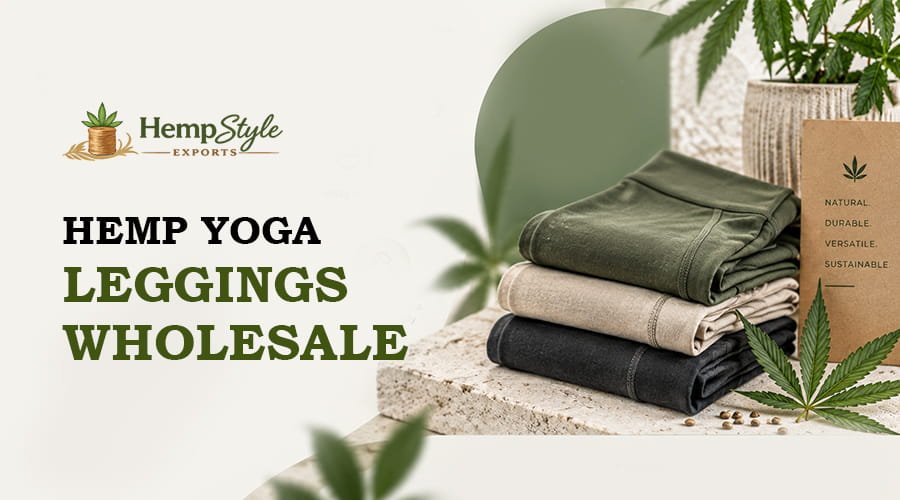
How Hemp Yoga Leggings Wholesale Pricing Works
Several variables move the number, and fibre cost is only one part of it.
Composition drives a lot. Higher hemp content generally costs more than cotton-heavy blends, since hemp processing remains less industrialised than cotton. Lyocell adds cost. Khadi sits in its own bracket entirely — hand-spun, hand-woven, and priced like it.
GSM affects price directly, no way around it. A 320 GSM legging simply uses more fabric than a 180 GSM one, and the quote reflects that plainly — nothing hidden about it.
Volume changes everything. Hemp yoga leggings wholesale pricing drops meaningfully between 1000 and 5000 units per style, often enough to reshape a brand’s whole margin strategy.
Construction adds cost. Flatlock seams, gussets, waistband pockets, side pockets, drawcords — each element takes machine time. Leggings with pockets cost noticeably more than plain ones, and brands underestimate this constantly.
Then the extras. Custom dyeing, Pantone matching, printing, embroidery, bespoke packaging, custom labelling. Specify all of it upfront rather than negotiating after samples land.
Freight belongs in the calculation too. Sea freight is cheaper and slower, air the reverse. Any brand launching to a fixed date needs to work backwards with real buffer, because production runs late and shipping runs later still.
Building a Full Range Around Custom Hemp T Shirts and Leggings
Very few brands sell leggings alone, and the smart ones plan the range together rather than piecing it out.
Custom hemp t-shirts pair naturally with legging ranges because they use compatible fabrics and can come from the same factory in the same production window. Hemp cotton jersey around 160 to 200 GSM handles the tees beautifully.
Tank tops are the easiest entry point for a new range. Simple construction, forgiving fit, quick to sample, cheap to produce relative to leggings.
Shorts need mediumweight blends with enough structure to avoid riding up during movement. Same fabric family as the leggings, different pattern challenges entirely.
Layering pieces — sweatshirts, joggers, wraps — sit in heavier GSM ranges and take advantage of hemp’s durability where garments get daily wear rather than studio-only use.
Colour consistency across the range matters more than brands expect. A tee and a legging in the same “black” that don’t quite match looks amateurish on a website grid. Order them together, dye them together, and specify that clearly.
Ordering custom hemp t shirts alongside leggings also helps on minimums, since combining styles sometimes improves overall pricing even when each style still needs to hit its own MOQ.
What a Good Manufacturer Should Offer
Website capability lists look identical across the industry. What separates suppliers shows up after the first technical email.
Sampling and prototyping should be standard. So should bulk manufacturing, private labelling, custom GSM and blend development, and export-ready production. Those five together let a brand start small and scale without switching partners halfway through growth.
Private labelling deserves particular attention. Neck labels, care tags, hangtags, packaging — every piece must arrive correct, since a well-made legging with the wrong care label creates compliance problems in several markets.
Custom blend development separates a real manufacturing partner from a catalogue seller. Ask for a specific hemp-cotton-spandex ratio at a particular GSM. A considered answer about whether it will actually hold shape tells you more than any brochure.
Quality control processes should be spelled out. What happens if a batch fails inspection? Who covers the cost? How fast does it get resolved? Those answers show how the relationship actually holds up when something goes wrong — and something eventually will.
Communication is undervalued. Response speed, clarity, willingness to disagree. A factory that says “that elastane percentage won’t recover at that GSM” is worth considerably more than one agreeing to every request.
Why India Has Become a Centre for Hemp Activewear Production
The geography isn’t accidental.
India has textile expertise stretching back generations, with deep knowledge of natural fibre processing that newer manufacturing regions simply haven’t built yet. Hemp, cotton, linen, khadi — all sit within an established skill base rather than being learned from zero.
Khadi is worth mentioning separately. Hand-spun and hand-woven, it produces texture no industrial process replicates, and blending it with hemp creates fabric available almost nowhere else on earth.
Yoga’s cultural origins matter more than people credit. Factories understand these garments because the practice is local rather than imported, and that understanding surfaces in construction details.
Cost structures stay competitive without the labour concerns attached to some sourcing regions, particularly at certified facilities operating under audited ethical standards.
There’s flexibility too. Manufacturers here will often quote smaller custom runs and bespoke blend development that higher-volume regions refuse outright.
Mistakes That Cost Brands an Entire Season
Rushing sampling tops the list every time. Two or three rounds is normal for leggings. Brands that jump straight to production almost always pay in returns and remakes.
Ignoring shrinkage runs a close second. Hemp and hemp blends shrink. Wash-test every sample before approval and build the allowance into the pattern rather than discovering it after two thousand units land.
Skipping opacity testing under stretch ruins legging ranges specifically. This is the single most common failure in the category.
Under-specifying elastane causes bagging at knees and waistbands. The fix costs nothing at sampling stage and everything after production.
Assuming print behaves like it does on cotton creates artwork problems. Hemp texture affects fine detail reproduction, so discuss designs with the factory before finalising files.
Underestimating lead times catches nearly everyone once. Sampling. Revisions. Approval. Production. Freight. Customs. Each one stretches longer than planned, and none of them wait politely for the last one to finish — they stack right on top of each other.
Where to Begin
Fabric swatches, before anything else. Hold a hemp-cotton-spandex knit next to a hemp-bamboo blend and you’ll settle arguments in five minutes that would otherwise drag on through three weeks of email threads. Manufacturers like Hemp Style Exports supply swatch sets and cover the whole process — sampling through export-ready bulk production — working with 100% hemp, hemp-cotton, hemp-cotton-spandex, bamboo, lyocell, khadi and trio blends out of their facility in India.
Once the fabric’s settled, the order matters: GSM, fit block, sampling, wash and stretch testing, approval, production, freight. Skip a step and it doesn’t just disappear — it comes back later as a problem, usually a bigger one.
Worth the Extra Work
Hemp asks more of a brand than polyester ever does. More questions about ratios. More rounds of sampling. More attention paid to how the fabric holds up after thirty washes, not just one. But here’s what you get back for the extra effort: activewear that actually lasts, smells better than it has any right to, and carries a sustainability claim nobody has to tiptoe around wording carefully. It just holds up.
For a label planning to still be here in five years, that trade looks reasonable enough.
